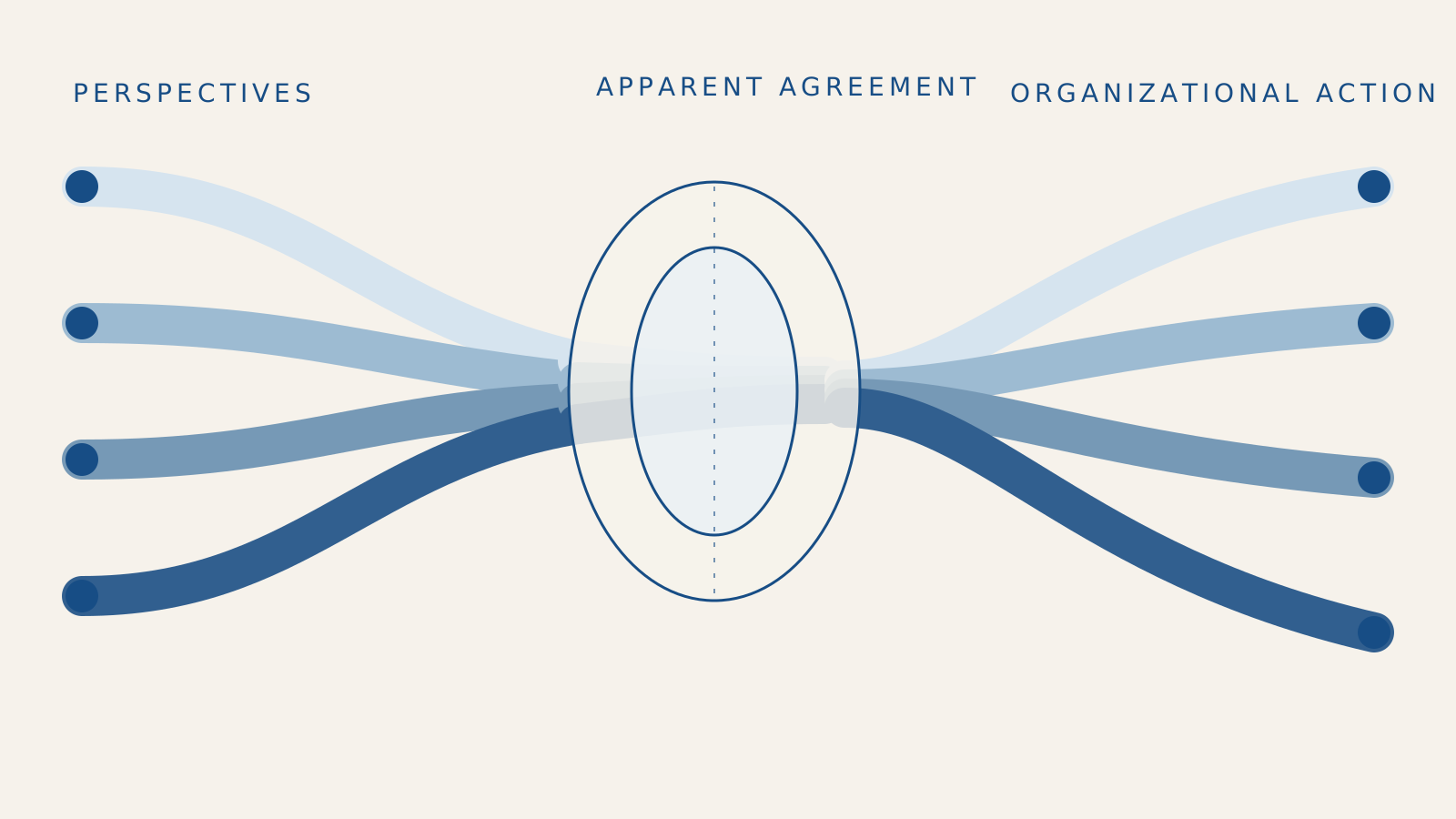
Leadership teams spend considerable time trying to create agreement. They debate priorities, test assumptions, resolve differences, and eventually reach a point where the strategy appears settled. People leave the room believing they understand the direction and what it requires.
That agreement matters. Research on strategic consensus has generally focused on the degree to which managers share an understanding of strategic priorities. A meta-analysis by Kellermanns and colleagues found a positive relationship between strategic consensus and organizational performance, although the strength of that relationship varied across organizational conditions. Earlier work by Floyd and Wooldridge also emphasized the importance of shared understanding and commitment among middle managers as strategy moves toward implementation.
Consensus, however, is not the same as complete organizational alignment.
What strategic consensus helps leaders understand
Strategic consensus asks whether a group of managers agrees about strategy-relevant content. Depending on the setting, that may include the organization’s priorities, competitive direction, goals, or the actions required to implement them. The underlying logic is practical: coordinated action is more likely when managers are not working from fundamentally different views of the strategy.
The concept also draws attention to where agreement exists. Consensus among a senior leadership team does not automatically mean that middle managers, frontline leaders, and employees hold the same understanding. Research in this area has therefore distinguished both the content of the agreement and the organizational level at which it is examined.
Shared mental model research offers a related view. It proposes that coordination is more effective when team members hold sufficiently compatible understandings of the task, roles, procedures, and one another’s responsibilities. People do not need identical knowledge, but they need enough common structure to anticipate how their work fits together.
What the Alignment Illusion adds
In Organizational Gap Framework research, the Alignment Illusion is the condition in which leaders perceive meaningful organizational alignment while material gaps among strategy, execution, and culture remain obscured. It does not assume that leaders are careless or that strategic consensus has no value. It asks whether the picture available to leaders is sufficiently complete.
A leadership team may reach genuine agreement about a strategic direction. The illusion can still emerge as that direction moves through the organization. Local priorities reshape the message. Resource decisions favor existing work. Incentives reinforce an older operating model. Employees learn that visible agreement is safer than raising concerns. Reports moving upward emphasize progress while unresolved contradictions remain in the day-to-day work.
In that situation, the organization may have achieved consensus in one room without developing alignment across the relationships that carry the strategy into action.
Agreement may change as it travels
The Organizational Gap Framework identifies two structural mechanisms that may contribute to the Alignment Illusion. Hierarchical filtering can alter information as it moves through organizational levels. Detail, ambiguity, and dissent may be reduced before the information reaches senior leaders. Performative compliance can make agreement visible even when behavior, resource allocation, or private interpretation remains inconsistent with the stated direction.
Neither mechanism requires deception. A manager can sincerely support the strategy while interpreting its implications differently from a colleague. A team can report progress against an assigned milestone while continuing to rely on routines that reinforce a previous priority. Employees can repeat the language of the strategy while remaining uncertain about what should change in their own work.
This is where strategic consensus, shared mental models, and the Alignment Illusion intersect. Consensus examines agreement. Shared mental models examine compatible understandings that support coordination. The Alignment Illusion examines whether leaders may be seeing evidence of agreement and coordination that masks consequential gaps elsewhere in the organization.
What leaders can examine beyond verbal agreement
A useful alignment conversation should not stop with whether people agree. Leaders can examine how the agreement is expressed in the operating system of the organization:
- Can people explain the priorities in their own words rather than repeat the formal language?
- Do teams understand what the strategy changes about their roles and decisions?
- Are resources, measures, incentives, and review routines consistent with the stated direction?
- Where do local interpretations differ, and are those differences consequential?
- What concerns are visible at the frontline but absent from leadership reporting?
- Does execution provide feedback that changes strategic assumptions?
These questions do not replace strategic consensus. They test whether the apparent agreement has become relationally coherent across strategy, execution, and culture.
A related idea, not a substitute
The OGF should not be treated as a replacement for the established literature on strategic consensus or shared mental models. Those concepts help explain important conditions for understanding, commitment, coordination, and implementation. The Alignment Illusion addresses a different problem: why leaders may conclude that the organization is aligned when the signals available to them remain incomplete.
The evidence is also at different stages. Strategic consensus and shared mental models have established empirical research traditions. The Alignment Illusion and the proposed relationships within the OGF are developing theoretical ideas grounded in qualitative research. Phase 2 research is intended to examine these relationships quantitatively.
Agreement in the room is valuable. It is not the end of the alignment process. The more important test is what happens when the strategy leaves the room and encounters the systems, routines, interpretations, and relationships through which the organization does its work.
Sources
Converse, S. A., Cannon-Bowers, J. A., and Salas, E. (1991). “Team member shared mental models: A theory and some methodological issues.” Proceedings of the Human Factors Society Annual Meeting, 35(19), 1417–1421. https://doi.org/10.1177/154193129103501917
Floyd, S. W., and Wooldridge, B. (1992). “Managing strategic consensus: The foundation of effective implementation.” Academy of Management Executive, 6(4), 27–39. https://doi.org/10.5465/ame.1992.4274459
Kellermanns, F. W., Walter, J., Floyd, S. W., Lechner, C., and Shaw, J. C. (2011). “To agree or not to agree? A meta-analytical review of strategic consensus and organizational performance.” Journal of Business Research, 64(2), 126–133. https://doi.org/10.1016/j.jbusres.2010.02.004
Wiersma, B. D., and Mitchell, M. C. (2026). “The alignment illusion: a relational theory of misalignment and the gaps that form in organizations.” Strategy & Leadership. https://doi.org/10.1108/SL-07-2026-0325