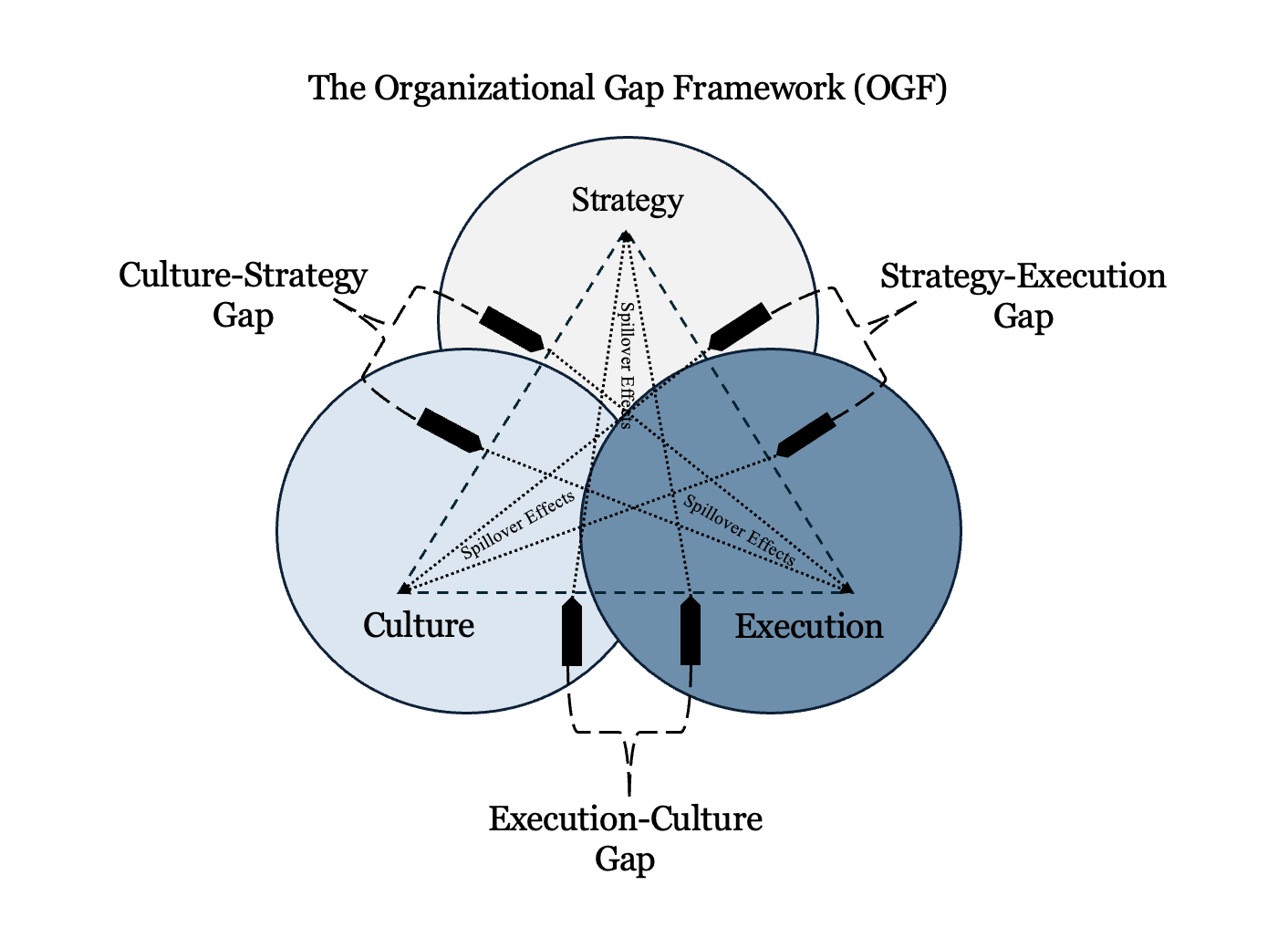
When organizational performance slips, leaders usually look for a problem inside one of the familiar categories. Is the strategy unclear? Is execution weak? Has the culture deteriorated?
Those are reasonable questions, but they assume the problem lives within a single domain. Sometimes the strategy is sound, the organization is capable of executing, and the culture has genuine strengths. The breakdown occurs in how those domains connect.
This is the central proposition behind the Organizational Gap Framework. Misalignment may form in the relational spaces between strategy, execution, and culture. The framework calls these spaces organizational gaps.
Imagine an organization with a clear growth strategy. The leadership team understands the direction and the operating teams are capable. Yet the existing planning process still allocates resources according to last year’s priorities. Nothing is obviously wrong with the strategy or with the people executing it. The problem sits between strategic intent and the systems that turn intent into action.
The same pattern can appear between execution and culture. An organization may sincerely value collaboration while rewarding individual performance in ways that discourage people from helping across functional boundaries. The stated culture and the execution system may each make sense on their own. Together, they send conflicting signals.
Looking at relationships changes the diagnostic task. Instead of asking only whether each domain is healthy, leaders examine whether the domains reinforce or contradict one another. That shift matters because an intervention aimed at the wrong place can leave the original problem untouched. A strategy refresh may not correct an incentive system that rewards outdated priorities. A culture initiative may not restore trust if recurring execution failures continue to undermine leadership credibility.
A useful starting point is to ask:
- Where does a clear intention become less clear as it moves into practice?
- What behaviors do our systems reward, and how do those behaviors compare with our stated values?
- Does our strategic direction make sense within the identity people attach to this organization?
An organizational gap is not proof that one domain is broken. It is a reason to examine whether the connection between two domains deserves attention. That distinction gives leaders a more precise place to look when familiar problems keep returning.