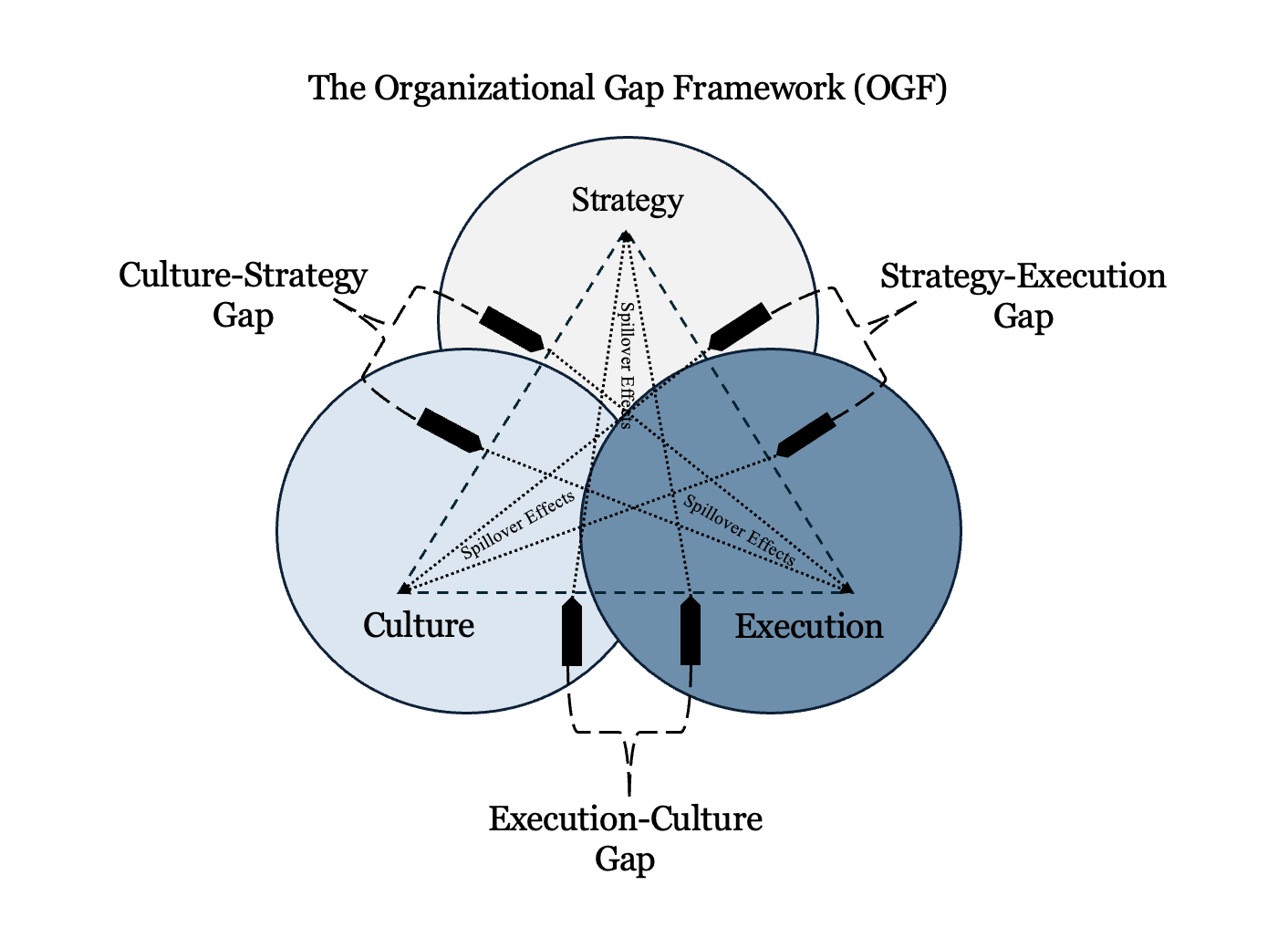
An organization sees growing cynicism and concludes that it has a culture problem. Leaders launch a culture initiative, revise the values, and invest in engagement. The response may improve for a time, but the cynicism returns.
The original problem may have started somewhere else.
The Organizational Gap Framework proposes that a persistent gap between two domains can create effects in the third. This is called spillover. A Strategy-Execution Gap may eventually erode trust and commitment in the culture. An Execution-Culture Gap may limit the organization’s ability to deliver its strategy. A Culture-Strategy Gap may weaken execution when people comply with a direction but withhold discretionary effort.
This matters because the visible symptom can draw attention away from the relationship where the misalignment began. If repeated execution failures have damaged leadership credibility, a culture intervention alone is unlikely to restore trust while those failures continue. If execution systems and cultural values are pulling in opposite directions, revising the strategy may leave the underlying conflict intact.
One nonprofit director in the OGF study described a highly relational leader whose organization had grown to the point that it needed stronger strategy, systems, and processes. The leader’s cultural strength did not compensate for the widening gap between strategy and execution. Frustration with that gap was beginning to affect the broader organization.
Spillover is a theoretical proposition that the next phase of OGF research is designed to examine. It should be used as a diagnostic possibility, not assumed as the explanation for every organizational problem.
When a symptom persists, leaders can ask:
- Where did this problem first become visible?
- What recurring gap may be producing pressure elsewhere in the organization?
- Are we intervening where the symptom appears or where the misalignment originates?
- What evidence would help distinguish between those explanations?
Organizational systems are interconnected, so problems may not remain neatly contained. Tracing the path of a symptom backward can help leaders consider whether they are treating a visible problem while leaving a possible source untouched.