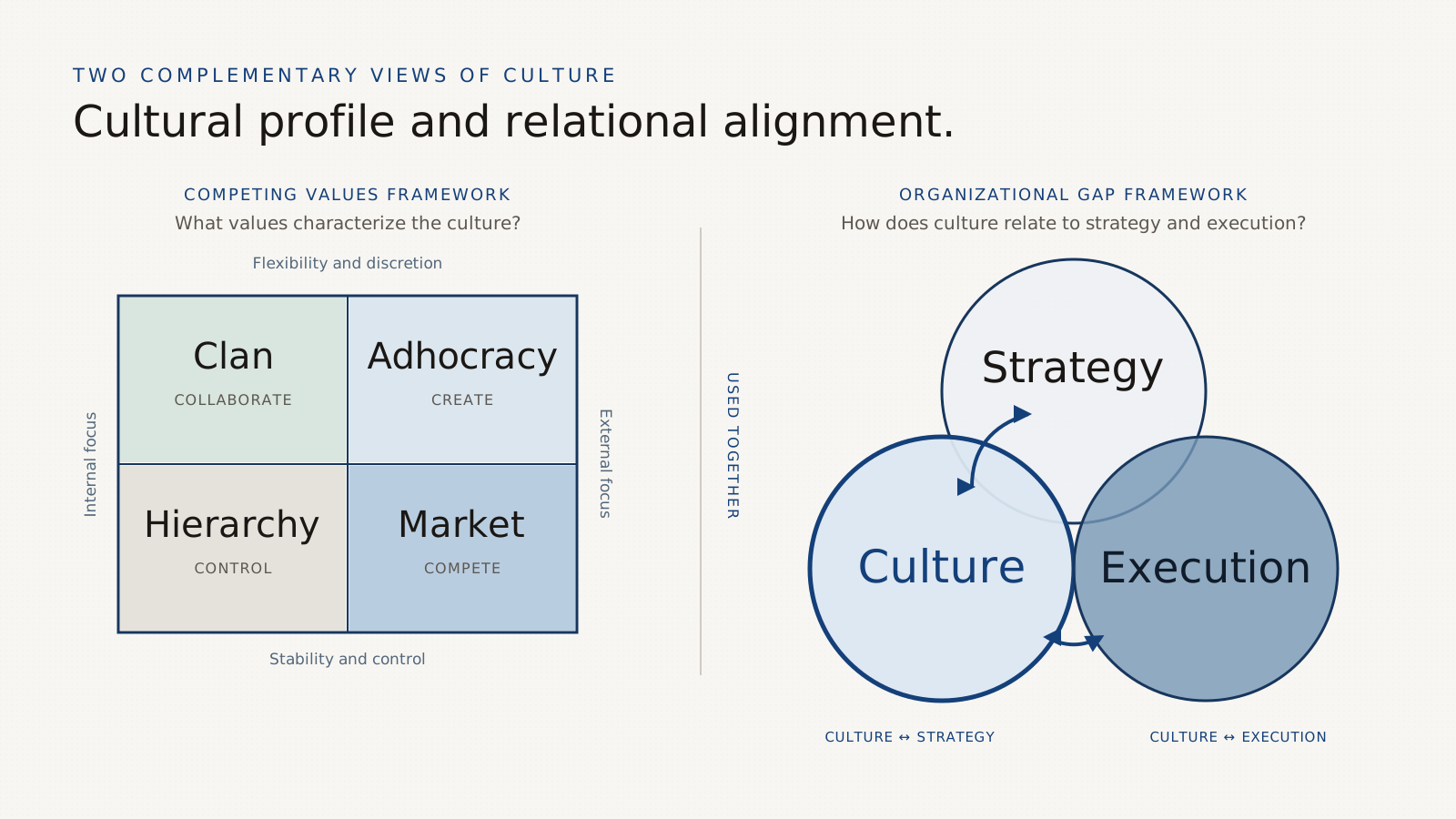
Culture is often discussed as though an organization has one defining quality. It is collaborative or competitive. Innovative or disciplined. Flexible or controlled.
Most organizations are more complicated than that. They need people to collaborate and produce results. They need room for experimentation and enough discipline to deliver reliably. The tension among those expectations is one reason culture can be difficult to describe and even harder to change.
The Competing Values Framework, developed through the work of Robert Quinn, Kim Cameron, and their colleagues, gives leaders a practical way to understand those tensions. The framework does not assume that one culture is universally best. It helps organizations examine the values they emphasize, the demands they are trying to balance, and the cultural movement they believe their circumstances require.
A framework that shaped my thinking
The Competing Values Framework has also influenced my own thinking about culture and leadership. I used the CVF and the Organizational Culture Assessment Instrument in my doctoral dissertation, and Kim Cameron and his team were exceptionally gracious in supporting my use of the framework in that research.
That experience deepened my appreciation for an idea at the center of Cameron and Quinn’s work: organizational effectiveness requires leaders to navigate competing values rather than search for one universally ideal culture.
The Organizational Gap Framework does not attempt to replace or restate the CVF. It addresses a different question. The comparison is useful because the CVF helps leaders understand the cultural profile of an organization, while the OGF examines how culture relates to strategic direction and the systems through which work is executed.
What the Competing Values Framework helps leaders see
In Diagnosing and Changing Organizational Culture, Cameron and Quinn organize the framework around two dimensions.
One dimension contrasts flexibility and discretion with stability and control. The other contrasts an internal focus and integration with an external focus and differentiation.
Together, those dimensions form four cultural orientations:
- Clan cultures emphasize collaboration, participation, cohesion, and development.
- Adhocracy cultures emphasize innovation, experimentation, adaptability, and growth.
- Market cultures emphasize competition, achievement, customers, and measurable results.
- Hierarchy cultures emphasize coordination, consistency, efficiency, and dependable processes.
These orientations are not four boxes into which organizations must be permanently sorted. An organization can exhibit all four, although some values will usually receive more attention than others. The Organizational Culture Assessment Instrument helps participants describe both the culture they currently experience and the culture they believe would better support future effectiveness.
This is one of the practical strengths of the CVF. It gives leaders a shared vocabulary for discussing cultural priorities without reducing the conversation to whether the culture is simply good or bad.
What the OGF asks differently
The Organizational Gap Framework treats culture as one of three organizational domains, alongside strategy and execution. Its central concern is relational: how those domains influence one another and where material gaps may form between them.
From this perspective, identifying a cultural profile is important but does not fully explain whether culture is aligned with the rest of the organization. The OGF asks how culture is affecting strategy and execution, and how strategy and execution are reshaping culture in return.
The relationship between culture and strategy
The OGF proposes two directions of influence across the Culture–Strategy boundary.
Strategy → Culture concerns how leaders connect strategic direction to meaning and identity. This includes sensegiving, involvement, narrative coherence, and whether people understand why the strategy fits who the organization is trying to become.
Culture → Strategy concerns how shared assumptions and identity enable or constrain strategic direction. A culture’s risk posture, adaptability, discipline, and beliefs about what is legitimate can make a strategy feel credible, unrealistic, or threatening.
A CVF profile can help leaders describe the cultural values present in that relationship. The OGF then asks whether those values are helping the strategy take hold or making the proposed direction harder for the organization to accept.
The relationship between culture and execution
The Execution–Culture relationship also works in two directions.
Execution → Culture concerns what operating systems teach people to value. Incentives, controls, decision rules, resource allocation, and performance measures signal which behaviors actually matter, regardless of what the organization says about its culture.
Culture → Execution concerns the norms and behaviors that support or constrain reliable action. Ownership, collaboration, candor, trust, and willingness to coordinate across boundaries can materially affect how work is carried out.
This distinction matters because an apparent culture problem may originate in the execution system. An organization may say it wants collaboration while rewarding individual competition. It may ask for innovation while using controls that punish unsuccessful experimentation. Over time, those systems can shape the culture employees experience.
Consider an organization seeking greater innovation
Imagine an established organization that wants to introduce a more innovative strategy. Its CVF assessment indicates a strong Hierarchy orientation and a desire for more Adhocracy characteristics.
The CVF helps leaders describe the cultural movement they believe is needed. The organization may need greater flexibility, faster experimentation, and more tolerance for novel approaches without abandoning the coordination and reliability that made it successful.
An OGF inquiry would extend the diagnosis. Has leadership connected the innovation strategy to the organization’s identity and history? Do employees see the strategy as a credible evolution or a rejection of what the organization values? Have approval processes, funding decisions, performance measures, and risk controls changed enough to permit experimentation? Does operational feedback reach the people who can adjust the strategy?
If the execution system continues to reward predictability and error avoidance, telling employees to become more innovative is unlikely to be sufficient. The organization may not simply have the wrong culture. It may have a gap between the culture it wants and the systems through which it manages work.
Using the frameworks together
The two frameworks can support different stages of the same leadership conversation.
- Use the CVF to understand the cultural profile. What values currently receive the most attention, what tensions are present, and what cultural movement may be required?
- Use the OGF to examine the relationships. How is the culture enabling or constraining the strategy? What are execution systems teaching people to value? Which cultural norms support or impede reliable action?
- Locate the intervention more precisely. Does the organization need cultural development, clearer strategic sensegiving, changes to execution systems, or coordinated movement across more than one boundary?
The CVF provides an established framework and widely used assessment approach. The OGF is a developing relational theory grounded in qualitative research, with its constructs and proposed pathways being prepared for quantitative testing. They should not be presented as equivalent in maturity or purpose.
Used together, however, they can help leaders avoid two common mistakes: treating culture as a single trait and treating every cultural concern as a problem located entirely within culture.
Questions for leadership teams
- Which cultural values receive the most attention in our organization today?
- What competing values must we balance rather than eliminate?
- Does our strategy build on the culture we have, or require cultural movement?
- What do our incentives, controls, measures, and decision rules teach people to value?
- Which cultural norms help people coordinate and execute reliably?
- Are we trying to change culture when another organizational relationship may be the more appropriate place to intervene?
Understanding an organization’s cultural profile is important. Understanding what that culture is doing in relation to strategy and execution may be just as important.
Sources
Cameron, K. S., and Quinn, R. E. (2011). Diagnosing and Changing Organizational Culture: Based on the Competing Values Framework (3rd ed.). Jossey-Bass. Publisher information.
Hartnell, C. A., Ou, A. Y., and Kinicki, A. (2011). “Organizational culture and organizational effectiveness: A meta-analytic investigation of the Competing Values Framework’s theoretical suppositions.” Journal of Applied Psychology, 96(4), 677–694. https://doi.org/10.1037/a0021987
Quinn, R. E., and Rohrbaugh, J. (1983). “A spatial model of effectiveness criteria: Towards a competing values approach to organizational analysis.” Management Science, 29(3), 363–377. https://doi.org/10.1287/mnsc.29.3.363
Wiersma, B. D., and Mitchell, M. C. (2026). “The alignment illusion: a relational theory of misalignment and the gaps that form in organizations.” Strategy & Leadership. https://doi.org/10.1108/SL-07-2026-0325