A strategy can be clear in the boardroom and still become difficult to recognize in the work of the organization.
Leaders may have identified the right priorities, communicated them repeatedly, and incorporated them into plans and presentations. Yet resources continue to follow older commitments. Teams make tradeoffs that pull in different directions. Measures reward activity that does not support the strategy. People can name the priorities but struggle to explain what those priorities require from them.
These are familiar signs of what is commonly called the strategy–execution gap: the difference between an organization’s strategic intent and what it is able to put into practice.
The problem has received considerable attention. Established approaches emphasize organizational capabilities, operating models, leadership involvement, resource allocation, clear priorities, and feedback. Each addresses an important part of the challenge. The Organizational Gap Framework offers a complementary way to think about the diagnosis.
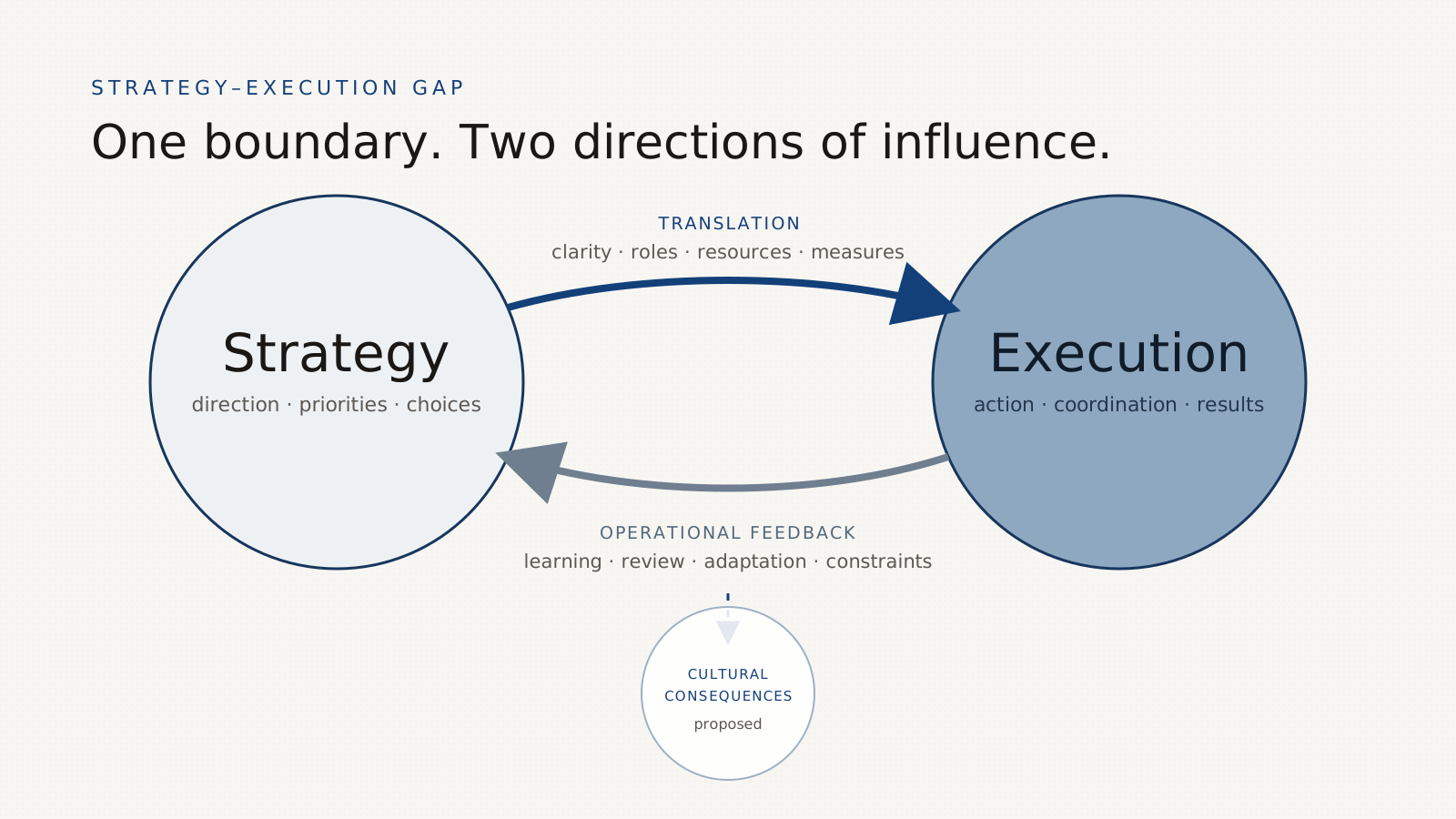
Rather than treating the strategy–execution gap as a one-way failure to carry a plan downward, the OGF examines the relationship between strategy and execution in both directions.
Why the gap is difficult to diagnose
The strategy–execution gap often becomes visible through symptoms.
An initiative misses its milestones. A new priority produces uneven adoption. Employees continue following old routines. Business units interpret the same strategy differently. Leaders respond by repeating the message, increasing accountability, adding measures, or changing personnel.
Any of those responses may be appropriate. The difficulty is knowing which one addresses the relationship that has weakened.
An execution problem may begin with a strategy that was never translated into meaningful choices. It may reflect insufficient capabilities or resources. It may result from incentives that favor existing work. It may also emerge because operational experience is not reaching the people responsible for revising the strategy.
The visible outcome can look similar even when the underlying explanation is different.
This is why established strategy-execution guidance covers such a wide range of practices. The Harvard Business Review collection on the topic includes arguments about capabilities, operating models, leadership responsibility, organizational tension, learning, and resource allocation. Leinwand, Mainardi, and Kleiner, for example, emphasize connecting strategy with the distinctive capabilities required to deliver it. Eric Garton focuses on whether the operating model supports the strategy. Roger Martin challenges the assumption that leaders create strategy while others are responsible for executing it.
These perspectives share an important premise: strategy and execution cannot be managed as separate activities.
What the OGF adds
The Organizational Gap Framework describes the Strategy–Execution Gap as a perceived inconsistency between strategic intent and its operational translation and implementation.
The framework divides the relationship into two directional pathways.
Strategy → Execution concerns the organization’s ability to translate strategic direction into operational reality. This includes clear priorities, role-level expectations, resource allocation, relevant measures, decision guidance, and communication specificity.
A strong strategic message is not enough. People must understand what the strategy changes, which choices it should influence, and what they are expected to do differently.
Execution → Strategy concerns the organization’s ability to use operational experience to refine strategic direction. This includes feedback from implementation, review cadence, follow-up discipline, learning from results, visibility into constraints, and adaptation when assumptions prove incomplete.
Execution does more than carry out strategy. It generates information about whether the strategy is workable. When that information does not travel back to decision makers, leaders may continue reinforcing a plan that operational experience has already called into question.
These directional pathways remain theoretical propositions that require further empirical testing. Their value at this stage is diagnostic. They help leaders examine both sides of the relationship before deciding why the gap exists.
Similar symptoms can point to different problems
Consider an organization that identifies customer responsiveness as a strategic priority. Six months later, response times remain inconsistent and customer complaints continue.
The immediate conclusion may be that teams have not executed the strategy.
That may be true. But several different conditions could produce the same result.
The strategy may not have been translated into clear service standards. Managers may understand the priority differently. Staffing and scheduling systems may still favor efficiency over responsiveness. Employees may not know which work should be delayed when customer needs conflict with internal tasks.
Those conditions point toward weakness in the Strategy → Execution pathway.
A different organization may have translated the priority clearly. Teams understand what is expected, but the promised response time is unrealistic given demand patterns, staffing levels, or technical constraints. Employees raise those concerns, yet the review process focuses on compliance rather than learning. The original target remains unchanged.
That points toward weakness in the Execution → Strategy pathway.
Both organizations have a strategy–execution gap. They do not have the same problem, and they should not expect the same intervention to work.
The gap may not remain between strategy and execution
The OGF also proposes that strain in one relationship may produce consequences elsewhere in the organization.
A persistent Strategy–Execution Gap may affect culture. When leaders repeatedly announce priorities that are not reflected in resources, measures, or operating decisions, employees may question whether the strategy is credible. Commitment can weaken. Cynicism can grow. People may learn to wait and see whether the latest priority survives before investing effort in it.
In that case, the cultural response is not necessarily the original source of the problem. It may be a consequence of the inconsistency employees have experienced between strategic messages and organizational action.
This proposed spillover effect is one reason the OGF considers strategy, execution, and culture together. The framework asks leaders to examine the boundary where a problem may have formed while remaining attentive to where its consequences are appearing.
Using established guidance and the OGF together
The OGF is not a replacement for established strategy-execution practices.
Organizations still need executable strategies, differentiated capabilities, supportive operating models, disciplined resource allocation, leadership involvement, and effective review processes. Those practices help organizations connect intent with action.
The OGF contributes a relational question: Which side of the strategy–execution relationship is currently weakening the connection?
Before selecting an intervention, leaders can ask:
- Can people explain what the strategy changes about their priorities and decisions?
- Have resources, incentives, and measures moved with the stated direction?
- Do teams understand what they should stop doing to make room for the strategy?
- Is operational feedback reaching the leaders responsible for strategic choices?
- Are review meetings being used to learn and adapt, or primarily to confirm compliance?
- Have repeated inconsistencies between strategic messages and organizational action affected trust or credibility?
The answers may not produce an immediate solution. They can, however, make the diagnosis more precise.
The strategy–execution gap is not always evidence that people failed to execute a good plan. It may reflect weak translation, inadequate support, limited feedback, an unwillingness to adapt, or some combination of these conditions.
Closing the gap begins with understanding the relationship that produced it.
Sources
Garton, E. (2017, November 22). “Is your company actually set up to support your strategy?” Harvard Business Review. https://hbr.org/2017/11/is-your-company-actually-set-up-to-support-your-strategy
Harvard Business Review. (2017). “The gap between strategy and execution.” https://hbr.org/insight-center/the-gap-between-strategy-and-execution
Leinwand, P., Mainardi, C., and Kleiner, A. (2015, December 22). “5 ways to close the strategy-to-execution gap.” Harvard Business Review. https://hbr.org/2015/12/5-ways-to-close-the-strategy-to-execution-gap
Martin, R. L. (2017, November 21). “CEOs should stop thinking that execution is somebody else’s job; it is theirs.” Harvard Business Review. https://hbr.org/2017/11/ceos-should-leave-strategy-to-their-team-and-save-their-focus-for-execution
Wiersma, B. D., and Mitchell, M. C. (2026). “The alignment illusion: a relational theory of misalignment and the gaps that form in organizations.” Strategy & Leadership. https://doi.org/10.1108/SL-07-2026-0325