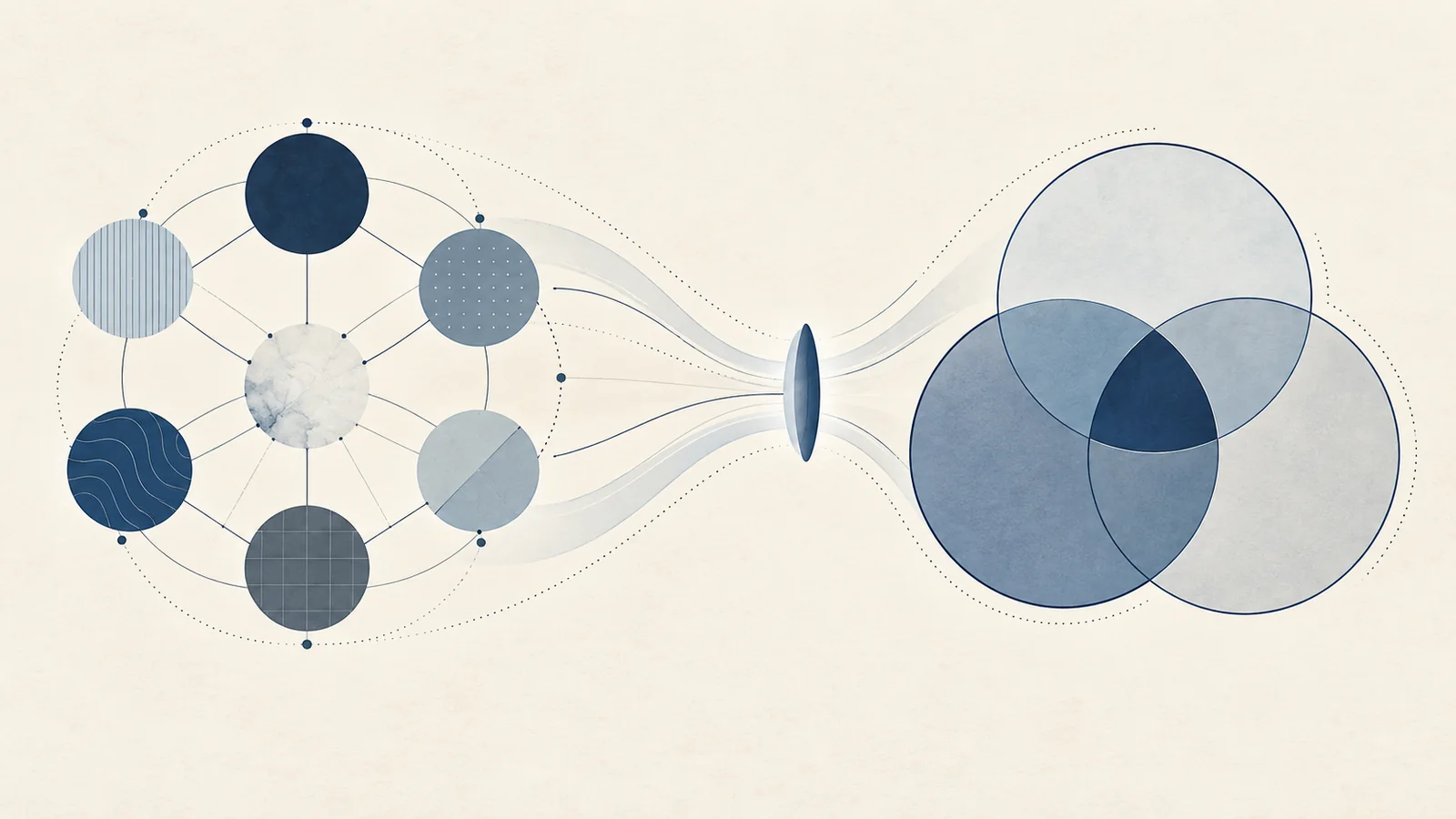
When an organization is not working as intended, structure is an easy place to look. Reporting lines can be redrawn, responsibilities reassigned, and new teams created. Yet the same problems often survive the reorganization. The boxes have moved, but the way the organization works has not.
The McKinsey 7S Framework was developed in response to this problem. Waterman, Peters, and Phillips argued that structure alone does not explain organizational effectiveness. Their framework asks leaders to consider seven interdependent elements: strategy, structure, systems, style, staff, skills, and shared values. The central idea is that organizational performance depends on the fit among these elements rather than the strength of any one element in isolation.
That idea has remained useful because it broadens the diagnosis. A strategy may be sound, but the systems may reward different behavior. The organization may have capable people, but lack the skills required by a new direction. Leaders may describe one set of shared values while their management style reinforces another. The 7S Framework gives leaders a way to examine the organization as a connected system.
The Organizational Gap Framework shares this concern with alignment, but approaches it from a different level. Rather than mapping seven organizational elements, the OGF concentrates on the relationships among strategy, execution, and culture. It asks where a gap may have formed, how influence moves in both directions across that gap, and whether the effects may be appearing somewhere else in the organization.
The difference is easier to see through an example. Imagine an organization pursuing a strategy built around a more consultative customer experience. Leaders communicate the change, redesign the structure, and invest in training. Yet operating systems still reward transaction speed and daily volume. Employees understand the strategy, but the measures and routines shaping execution point elsewhere.
A 7S review would help leaders examine whether the strategy, systems, skills, staff, style, structure, and shared values support one another. That broader view may reveal several elements that require attention. The OGF would place additional emphasis on the boundaries. Is strategy being translated into execution priorities? Are execution systems shaping a culture that values speed over consultation? Is the resulting behavior feeding back to leaders in a way that makes the strategy appear more workable than it is?
These are related questions, but they are not identical. The 7S Framework helps leaders assess organizational fit across a broad set of elements. The OGF offers a more focused vocabulary for examining the relational pathways connecting three domains. Its proposed spillover logic also asks whether a visible culture problem, for example, may have originated in the relationship between strategy and execution.
The frameworks may therefore be more complementary than competitive. The 7S Framework is useful when leaders need a comprehensive view of the organization, particularly during a major change, reorganization, or strategic shift. The OGF may be useful when leaders can see a recurring symptom but are less certain where the misalignment began. One maps the wider organizational system. The other narrows attention to the gaps and directional influences within it.
There is also an important difference in maturity. The 7S Framework has been used for decades as a management diagnostic. The OGF is a developing theory grounded in qualitative research, with its directional pathways and spillover propositions still requiring further empirical testing. It should be used as a structured lens for inquiry rather than a validated scoring instrument.
Neither framework removes the need for leadership judgment. Both challenge the assumption that an organizational problem can be understood by examining one component at a time. The practical question is what kind of view the situation requires. If leaders need to assess the broader configuration of the organization, 7S offers a useful map. If the elements appear reasonable on their own but the organization still feels disconnected, the relationships between them may deserve closer examination.
When a 7S review reveals several points of misalignment, the OGF can help narrow the inquiry. Leaders can ask:
- Which organizational elements appear out of alignment?
- Which relationship is failing to carry influence in the expected direction?
- Could the symptom receiving attention have originated in an adjacent gap?
Used together, the frameworks can move the conversation from a list of organizational components to a more specific examination of how those components are affecting one another. That distinction matters because an organization can possess the right elements and still struggle in the spaces between them.
Sources
Waterman, R. H., Jr., Peters, T. J., and Phillips, J. R. (1980). “Structure is not organization.” Business Horizons, 23(3), 14–26. https://doi.org/10.1016/0007-6813(80)90027-0
Wiersma, B. D., and Mitchell, M. C. (2026). “The alignment illusion: a relational theory of misalignment and the gaps that form in organizations.” Strategy & Leadership. https://doi.org/10.1108/SL-07-2026-0325